
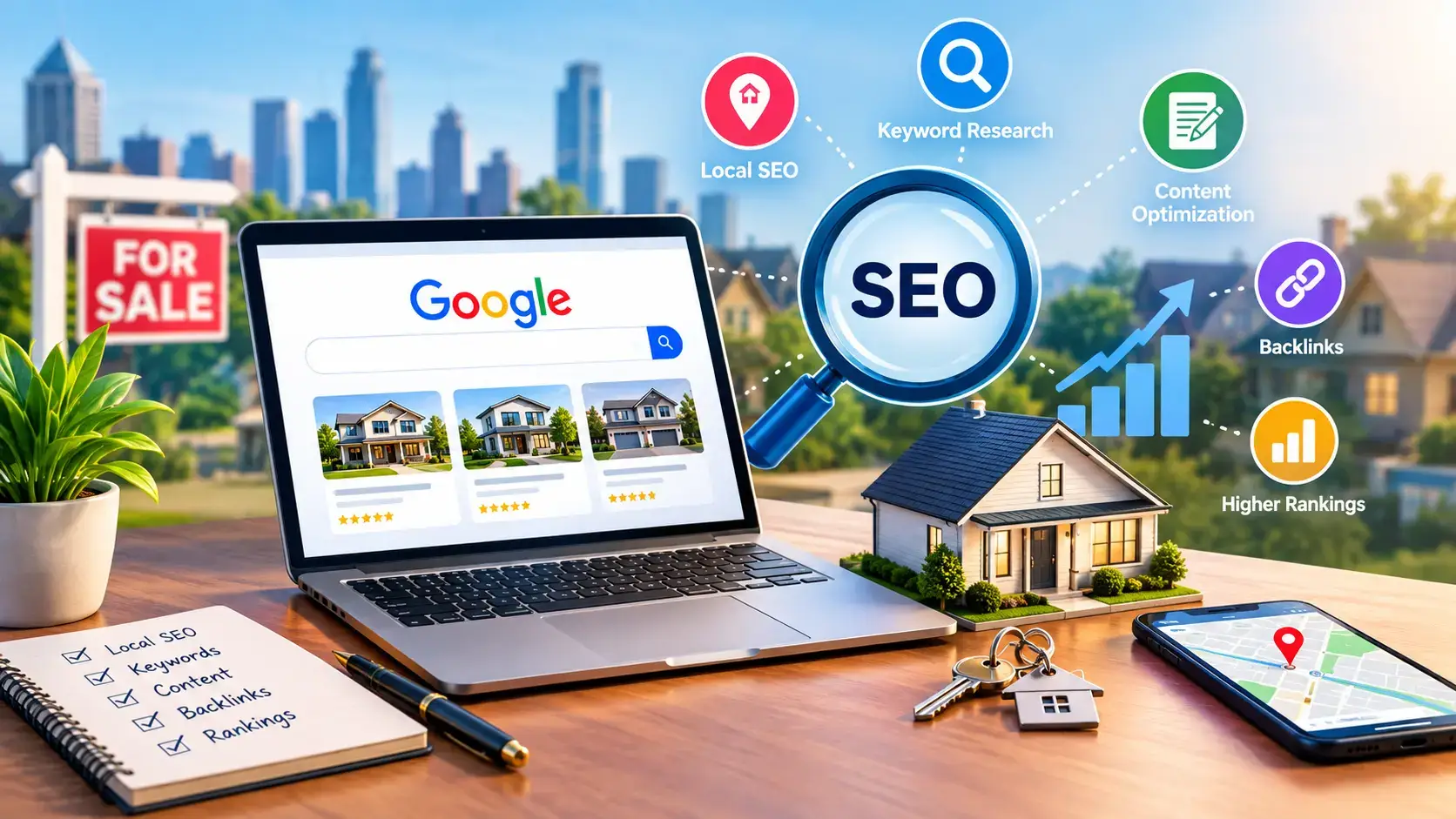
Real estate SEO is the process of optimizing a property website, agent profile, listings, and local digital presence so buyers, sellers, landlords, tenants, and investors can find the right real estate business at the moment they are ready to act.
Table of Contents
Understanding the Modern Real Estate Search Landscape
Traditional property discovery depended heavily on portals, newspaper advertising, referrals, and brokerage networks. Search behavior has changed. A buyer may now search “two-bedroom apartments near downtown,” compare neighborhood information on mobile, inspect a map listing, and then ask an AI assistant which areas fit a particular budget.
That shift makes property search optimization a demand-capture system rather than a simple keyword exercise. The goal is to connect a brand with geographic, property-type, and transactional intent while making the website understandable to search engines and people.
Effective property search strategy starts with understanding the customer journey. Someone searching “homes for sale in Austin” has broad local intent. A query such as “new construction homes in North Austin under $600k” is more specific and commercially valuable. Investor searches, rental searches, and commercial queries require different landing pages, content, and conversion paths.
Mobile usability is equally important. Property websites are often image-heavy, contain map interfaces, filters, videos, mortgage calculators, and IDX or MLS-connected inventory. If those experiences are slow or difficult to use, rankings and conversions can suffer together.
On-Page and Local SEO Strategies

Build Hyperlocal Neighborhood Pages:
Location is one of the strongest signals in property search. Instead of publishing one generic “homes for sale” page, create useful pages around cities, suburbs, neighborhoods, communities, and property types.
A strong neighborhood page should answer questions such as:
- What types of properties are available?
- What is the typical price range?
- Which amenities and transport options are nearby?
- Who is the neighborhood suitable for?
- How does it compare with nearby communities?
- What local market trends matter to buyers or sellers?
Avoid producing dozens of nearly identical city pages with only the location name changed. Each page should contain genuinely local information, unique market context, internal links to relevant listings, and clear next steps.
Optimize IDX and Property Listing Pages
IDX feeds can expose a large inventory of properties, but indexing every filter combination is rarely the best strategy. Search engines can encounter thousands of URLs with minimal unique value.
Prioritize indexable pages that have meaningful search demand, such as:
- Condos for sale in a defined neighborhood
- Luxury homes in a specific city
- Commercial properties for lease in a business district
- Investment properties near a major employment center
Give important listing pages descriptive titles, unique property descriptions, optimized images, useful internal links, and accurate availability information. Canonicalization, crawl controls, pagination, and URL parameters should be reviewed carefully when an IDX platform generates dynamic pages.
Strengthen Google Business Profile Visibility
For agents and brokerages serving a defined market, the Google Business Profile is a critical local asset. Complete the profile accurately, select the most appropriate categories, maintain current contact information, add high-quality property and team photographs, and publish relevant updates.
Reviews also matter for trust and local visibility. Establish a legitimate process for requesting reviews after completed transactions, and encourage clients to describe their actual experience without scripting artificial keywords.
For local property SEO, local consistency matters beyond Google. Business name, address, phone number, website information, and professional details should remain accurate across reputable directories, associations, chamber websites, and relevant property platforms.
Use Structured Data Correctly
Structured data helps search engines interpret entities and relationships. Depending on the page, relevant Schema.org types may include RealEstateAgent, SingleFamilyResidence, and Offer, alongside appropriate Organization, LocalBusiness, PostalAddress, ImageObject, and BreadcrumbList markup.
For a property page, ensure the structured information matches visible page content. Property price, address, availability, images, and other attributes should not be invented or marked up inaccurately.
Schema is not a shortcut to rankings, but accurate structured data can improve machine understanding and eligibility for certain search features.
SEO for Real Estate Investors vs. Commercial Property

Seo for real estate investors requires a different intent model from conventional buyer acquisition. An investor may search for “sell my house fast,” “cash home buyers,” “distressed properties,” “rental property analysis,” or “multifamily investment opportunities.”
The website should map content to each stage:
- Awareness: Explain local market conditions, property investment risks, and common seller situations.
- Evaluation: Publish deal-analysis guides, renovation considerations, financing explanations, and neighborhood investment research.
- Conversion: Create focused pages for cash offers, property evaluations, acquisitions, or consultation requests.
A motivated-seller funnel should minimize friction. Use concise forms, clear expectations, local proof, transaction experience, and transparent qualification criteria. The landing page should answer why the investor is credible before asking for sensitive property details.
Develop Commercial Real Estate Authority
A commercial real estate seo company should build topical authority around asset classes and transaction types rather than relying only on broad terms such as “commercial real estate.”
Create dedicated resources for:
- Office properties
- Retail centers
- Industrial warehouses
- Multifamily assets
- Land and development opportunities
- Medical office space
- Hospitality properties
- Investment and leasing opportunities
Each commercial page should address location, asset class, tenant or buyer intent, investment considerations, zoning or use information where appropriate, and relevant market context. For example, an industrial property page can connect warehouse listings with logistics corridors, transportation access, tenant requirements, and local development trends.
For B2B leads, conversion paths should also reflect the transaction. Offer downloadable market reports, valuation consultations, property alerts, broker conversations, or investment briefings instead of generic “Contact Us” forms alone.
The Role of AI in Modern Search
AI has changed how users discover businesses and properties. Google AI Overviews, ChatGPT, Perplexity, and other answer engines can synthesize information from multiple sources rather than simply presenting ten blue links.
That means property search optimization increasingly depends on entity clarity, factual consistency, topical authority, and the availability of trustworthy supporting information. Search systems need to understand that a brokerage serves a particular market, that an agent is associated with a company, that a neighborhood has specific characteristics, and that a property belongs to a particular category.
Optimize for Generative Discovery:
An ai seo company working in this space should focus on making a real estate brand easy for machines to identify, verify, and summarize. That includes consistent business information, strong first-party content, expert authorship, structured data, authoritative citations, local references, and relationships with reputable industry sources.
Specialized ai seo company providers can also coordinate this work. Specialized ai search engine optimization services can extend this work by auditing how a brand is represented across search and generative environments, identifying information gaps, improving entity signals, and developing content designed around conversational discovery.
Choosing an SEO Expert, Agency, or Internal Team

A solo agent with one market and a manageable website may handle basic optimization internally. Once a brokerage operates across multiple locations, publishes hundreds of listings, uses IDX, manages several agents, or competes for commercial and investor searches, the technical workload increases significantly.
A real estate seo expert can diagnose indexing problems, build location architecture, develop content priorities, improve conversion paths, and coordinate technical changes with developers. The right specialist should be able to explain what is being changed, why it matters, and how results will be measured.
A real estate seo company becomes more useful when you need a combination of technical SEO, content production, local optimization, digital PR, analytics, and ongoing testing. Ask potential providers for evidence of methodology rather than guarantees of a specific ranking position.
When to Keep SEO In-House
An internal team can work well when you already have:
- A technically capable website team
- A content specialist who understands search intent
- Reliable analytics and reporting
- Someone responsible for local listings and reputation
- A process for implementing technical recommendations
Measure SEO by Revenue, Not Rankings Alone
The strongest organic programs connect organic visibility to business outcomes. Rankings can be useful diagnostic metrics, but they are not the final objective.
Track KPIs such as:
- Organic qualified leads
- Calls and form submissions
- Property inquiry volume
- Lead-to-appointment rate
- Appointment-to-transaction rate
- Organic-assisted conversions
- Cost per organic lead
- Local pack visibility
- Non-branded organic traffic
- Listing-page engagement
- Revenue influenced by organic search
A useful reporting model separates branded traffic from non-branded demand and distinguishes buyers, sellers, renters, investors, and commercial prospects. This makes it easier to identify which pages and queries generate actual business value.
A Practical Growth Framework
For most property businesses, the strongest sequence is straightforward. First, fix technical accessibility and indexation. Second, build a logical city, neighborhood, property-type, and service architecture. Third, optimize the Google Business Profile and local citations. Fourth, publish genuinely useful market and property content. Fifth, strengthen authority through relevant local relationships and editorial coverage. Finally, expand into AI search optimization as the brand’s entity and topical authority mature.
A real estate seo expert should continuously connect these activities to commercial intent rather than chasing traffic for its own sake. For businesses targeting investors, seo for real estate investors should prioritize motivated-seller intent, local market intelligence, and high-conversion acquisition pages. For larger B2B portfolios, a commercial real estate seo company should build authority around asset classes, locations, transactions, and investment questions.
The next stage is to make the brand understandable wherever customers search. That is why ai search engine optimization services are becoming an important extension of conventional organic strategy. A strong program combines technical accessibility, local relevance, authoritative content, credible entities, and measurable conversion paths.
Ultimately, property SEO works best when search visibility becomes part of the entire acquisition system. The objective is not merely to rank a brokerage website; it is to make the right property, service, agent, or investment opportunity discoverable to the right person, in the right location, at the right stage of intent.
Frequently Asked Questions (FAQs)
Real Estate SEO is the process of optimizing property websites, listings, location pages, and local business profiles to improve search visibility and attract high-intent buyers, sellers, renters, and investors.
SEO helps real estate businesses attract qualified organic traffic from people actively searching for properties, agents, neighborhoods, investment opportunities, and real estate services.
Results vary depending on competition, website authority, technical health, content quality, and location. Some improvements may appear within weeks, while competitive markets often require several months of consistent optimization.
Agents can generate leads by optimizing property and neighborhood pages, targeting local search terms, improving their Google Business Profile, publishing useful market content, and creating clear conversion paths for calls, inquiries, and consultations.
Yes. SEO can help investors reach motivated sellers and potential investment clients through targeted content about cash offers, distressed properties, rental investments, local markets, and property acquisition opportunities.
AI search engines can influence how buyers discover real estate brands and local property information. Strong entity signals, authoritative content, structured data, consistent business information, and reputable online references can improve how a brand is understood and represented in AI-driven search.
Leave a Reply